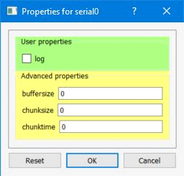
These settings control incoming-data buffering and retry timing, not the baud rate of a physical COM port. Zero buffer values select automatic defaults; they do not disable buffering. The effective timing also depends on whether the port has a physical serial connection, as described under chunktime below.
The [+] settings apply to the selected emulated i16550 port, including an individual port on an additional serial card. Incoming bytes first enter a larger queue, then move into a smaller buffer from which the guest reads them. These are not the physical host COM driver's buffers.
log (default: false)
Write diagnostic text records for guest serial output to the main emulator log. Records are emitted at a carriage return, line feed, or when the internal text buffer fills. NUL bytes are omitted, line terminators are not preserved as data, and an unfinished final line may not be recorded. This is useful for correlating low-volume console messages, not a byte-for-byte transcript or separate capture of input keystrokes. For a separate serial-output file, use Serial Port Logging. Neither option guarantees capture of guest input that the guest does not echo.
buffersize (default: 0, automatic)
Capacity in bytes of the larger incoming queue. A positive value sets that capacity explicitly. Zero selects 16 bytes when this port has a physical serial connection, or 16777215 bytes otherwise. The implementation reserves one additional ring-buffer slot; the startup diagnostic reports allocated sizes, one larger than usable capacities. Choose a practical size that fits available host memory. If this queue fills before input can be transferred, Avanti reports a serial port buffer overrun and drops input that does not fit; it does not guarantee lossless delivery or wait for space.
chunksize (default: 0, automatic)
Capacity in bytes of the smaller guest-facing input buffer. A positive value sets that capacity explicitly. Zero selects 1 byte with a physical serial connection, or 9 bytes otherwise. The effective chunksize must not exceed the effective buffersize, including when one value remains automatic; for example, buffersize=4 with automatic chunksize is invalid without a physical connection. A chunk is a buffer refill, not a packet boundary or a promise that the guest reads that many bytes at once.
Both size settings accept nonnegative whole-byte values and binary K/M/G/T suffixes; for example, 1K means 1024 bytes. Zero means automatic, not an empty buffer. Leave the defaults unless there is a specific need to tune input buffering. Larger buffers consume more host memory and do not solve a persistently slower receiver.
chunktime (default: 0; range: 0 through 2147483647)
Retry delay in milliseconds when queued input cannot yet fit in the smaller input buffer. It is not a guaranteed character transmission rate. A nonzero value is used as specified. With zero, a port without a physical serial connection substitutes 10 milliseconds if either buffersize or chunksize is also zero; otherwise no additional timer delay is requested. The upper limit prevents integer overflow, not a recommendation to use long delays: an excessive setting can make pending serial input appear unresponsive.
Configuration-file compatibility setting
commsync (default: true) is hidden from the [+] dialog but remains active in the emulated UART. It enables modem-status-change indications after line-control or modem-control register writes. It is not a host baud-rate, buffering, or throughput control. Leave it at its compatibility default unless investigating a specific guest-driver requirement.